
In November 2025, the Trump administration revealed a national security strategy that reinterprets the historic Monroe Doctrine. This new approach includes what they call the “Trump Corollary.” The administration aims to reassert American power in the Western Hemisphere, making it clear that the U.S. wants to maintain its influence in the region.
The strategy highlights concerns about China’s growing role in Latin America. The Trump administration plans to prevent countries in the hemisphere from working closely with non-Hemispheric competitors like China. This includes denying them the ability to place military forces or other threatening capabilities nearby. The Monroe Doctrine has historically been used as a justification for U.S. interventions in Latin America, and the administration’s approach echoes this sentiment.
The U.S. is worried about China’s involvement in technology, trade, and even drug trafficking in the region. To counter this, the administration intends to use various pressures, including sanctions, to steer Latin American governments away from Beijing. However, the U.S. has limited options to offer these countries compared to China’s investment proposals. Additionally, this strategy reflects an effort to contain China while asserting U.S. dominance in the region.
The U.S. seeks to counter China’s growing influence in Latin America through sanctions, despite having fewer incentives to offer.
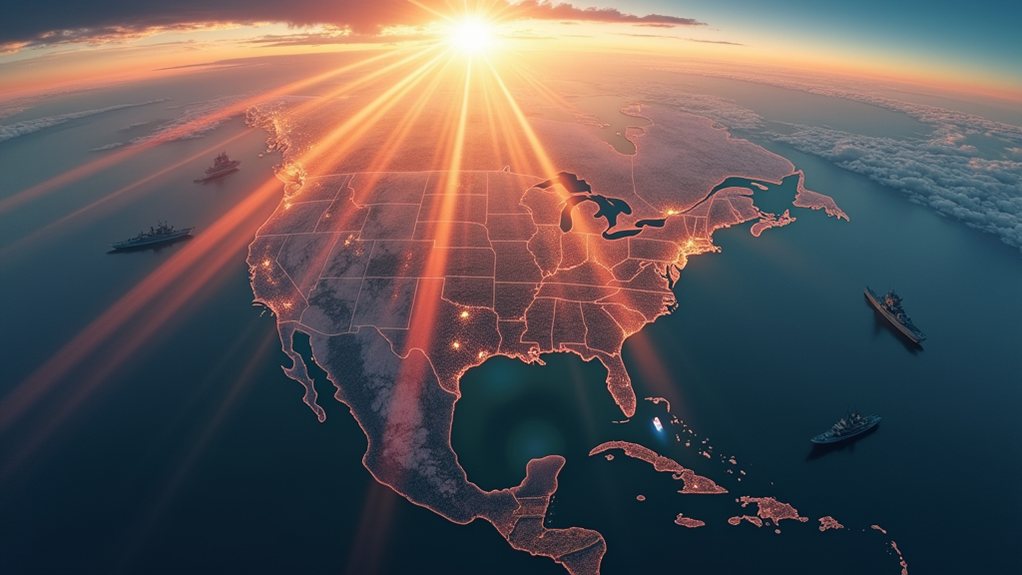
The strategy also shows a readiness for military action. Trump has threatened to invade Venezuela and previously suggested launching missiles into Mexico to combat drug issues. There has been a noticeable increase in U.S. military assets in Puerto Rico, suggesting a focus on projecting power in the region.
Trump also offered to send troops to Mexico to fight drug trafficking, although that offer was declined.
Trump’s administration has made bold moves for territorial expansion as well. On his first day back in office, an executive order renamed the Gulf of Mexico to the Gulf of America. There have also been attempts to acquire the Panama Canal and even Greenland.
The administration’s hardline immigration plans include mass deportations and military deployments in the Caribbean, marking a severe shift in how the U.S. approaches migration from Latin America. This strategy aims to create division among populations in the region, portraying migrants as a threat to national security.