In recent years, the relationship between Panama and the United States has faced renewed tension over control of the Panama Canal. The Canal, essential for global trade, was built by the U.S. between 1904 and 1914 at a cost of $375 million. For many years, the U.S. maintained sovereignty over the Canal Zone until the Torrijos-Carter Treaties in 1977 agreed to transfer control to Panama. This transfer was gradual and completed on December 31, 1999, granting Panama full control.
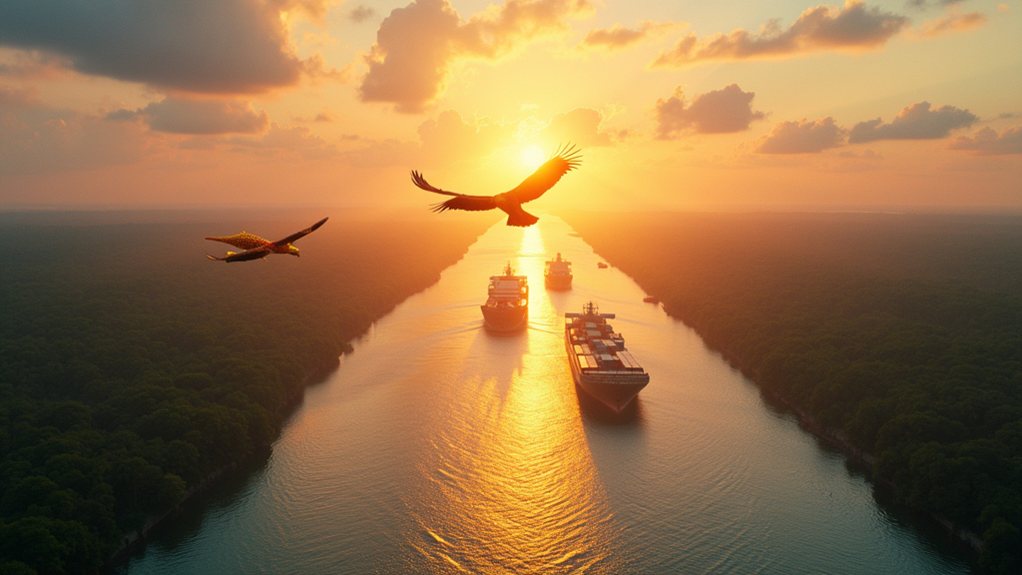
The Panama Canal is significant as about 6% of global maritime trade passes through it. It shortens the distance between the Atlantic and Pacific Oceans by 8,000 miles. Additionally, 40% of U.S. container traffic uses the canal annually, making it important for U.S. naval strength and global supply chains. U.S. acquired rights to build and operate the canal in the early 20th century, which laid the groundwork for its strategic importance in international trade. Moreover, the canal plays a critical role in global supply chains by facilitating the movement of various commodities, supporting industries that rely on just-in-time delivery.
About 6% of global maritime trade utilizes the Panama Canal, crucial for U.S. container traffic and naval strength.
Recently, former President Trump raised concerns about the Canal, especially regarding Chinese influence and rising transit fees. He threatened to "take back" the canal and ordered military plans that ranged from partnership to potential seizure. He claimed that the canal is a "critical national asset" for the U.S. economy. This sparked diplomatic tensions between the two countries. The constitutional requirements for declaring war in the United States, as outlined in Article I, Section 8, highlight that only Congress has the authority to declare war, which could play a role in any potential military action.
In response, Panama's President Mulino stated that the country's sovereignty is "non-negotiable." The Panamanian government rejected the idea of returning control to the U.S. They emphasized how well the canal has been managed since the handover in 1999, highlighting a $5 billion expansion completed in 2016.
Panama has also built ties with China, which raised fears in the U.S. about surveillance and control over maritime traffic. China's involvement complicates U.S.-Panama relations as the U.S. remains the largest user of the canal.
However, legal and diplomatic hurdles exist for any U.S. reclamation, including the 1977 Neutrality Treaty. This treaty commits the U.S. to respect the canal's neutrality and could damage relations across Latin America if violated.